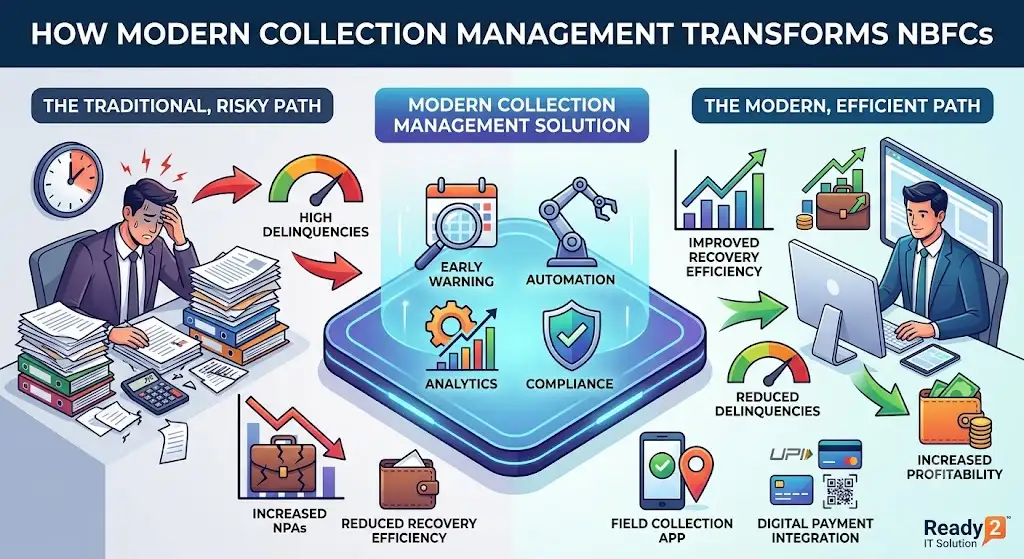

How Modern Collection Management Helps NBFCs Reduce Delinquencies and Improve Recovery Efficiency
Collections Is No Longer Just About Recovery
For many lenders, collections begin when an EMI is missed. In reality, effective collections management starts much earlier.
Modern NBFCs, Housing Finance Companies (HFCs), Microfinance Institutions (MFIs), and Fintech lenders understand that successful collections are not simply about chasing overdue payments. They are about identifying risk early, improving borrower engagement, reducing delinquency, and maintaining portfolio health throughout the loan lifecycle.
As lending portfolios grow, manual collection processes, spreadsheets, disconnected field teams, and delayed reporting create operational challenges that directly impact recoveries and profitability.
This is why lenders are increasingly adopting a modern Loan Collection Management System that combines automation, mobility, analytics, compliance, and real-time visibility into one unified platform.
The Growing Challenge of Loan Collections
Every lending institution faces a common challenge:
How do you ensure timely repayments while maintaining a positive borrower relationship?
As loan books expand, lenders must manage:
- High collection volumes
- Multiple geographic locations
- Different loan products
- Field collection teams
- Regulatory requirements
- Delinquency monitoring
- Recovery tracking
Without the right technology, collection operations become reactive rather than proactive. The result is higher delinquency rates, increased NPAs, rising operational costs, poor customer experience, and reduced recovery efficiency.
Understanding the Collection Lifecycle
A structured collection strategy follows multiple stages:
1. Repayment Monitoring
The process begins with continuous monitoring of borrower repayment behavior. A modern Collection Management System automatically tracks:
- EMI due dates
- Payment status
- Bounce cases
- Partial payments
- Missed installments
This enables lenders to identify risk before serious delinquency develops.
2. Early Warning and Delinquency Management
Not every missed payment leads to default. Early intervention often prevents accounts from deteriorating. The system should automatically classify accounts into:
- SMA-0 (1-30 Days Past Due)
- SMA-1 (31-60 Days Past Due)
- SMA-2 (61-90 Days Past Due)
This helps collection teams prioritize accounts based on risk and urgency.
3. Collection Assignment
Once delinquency is identified, cases are assigned to collection executives, relationship managers, recovery officers, and agency partners. Automated assignment rules ensure cases reach the right team instantly.
4. Field Collections
For lenders operating across large geographical regions, field collections remain critical. Collection teams require access to customer profiles, outstanding balances, visit schedules, payment history, and collection remarks. A mobile-first collection platform ensures recovery teams can operate effectively from any location.
5. Legal and Recovery Actions
When standard recovery efforts fail, lenders may initiate legal notices, settlement discussions, asset recovery, SARFAESI actions, and write-off workflows. Tracking these activities centrally improves control and compliance.
Why Traditional Collection Processes Fail
Many lenders still rely on Excel sheets, manual reminders, offline tracking, phone-based reporting, and fragmented systems. These approaches create several problems:
Limited Visibility
Management lacks real-time portfolio information.
Delayed Actions
Collection teams act only after delinquency worsens.
Poor Productivity
Field executives spend more time reporting than collecting.
Data Quality Issues
Manual updates often lead to inaccuracies.
Compliance Risks
Incomplete audit trails make regulatory reviews difficult.
In a competitive lending environment, these inefficiencies directly impact profitability.
What a Modern Collection Management System Should Offer
Real-Time Portfolio Monitoring
Collection leaders should have instant access to collection performance, delinquency trends, recovery metrics, team productivity, and NPA movement. Real-time visibility enables faster corrective actions.
Automated Workflow Management
Automation removes manual effort from routine tasks such as payment reminders, collection allocation, escalation triggers, follow-up schedules, and recovery tracking. This improves efficiency while reducing human error.
Collection Mobile Application
Field teams should be able to view assigned cases, record visits, capture payment commitments, update collection status, upload documents and photos, and work in real time. Mobile enablement significantly improves field productivity.
Digital Payment Integration
Modern borrowers expect convenient repayment options. Collection systems should support UPI, Net Banking, Payment Links, Auto Debit, and QR Code Payments. Simpler payments typically result in higher recovery rates.
Analytics and Recovery Insights
Advanced dashboards should help lenders answer questions such as: Which regions have the highest delinquency? Which products show greater repayment risk? Which collection officers perform best? What factors drive default behavior? This transforms collection operations from reactive to predictive.
Introducing R2S Collection Management Solution
The R2S Collection Management Solution is designed to help NBFCs, HFCs, MFIs, and Fintech lenders manage the complete collection lifecycle through a centralized, technology-driven platform.
Built as part of the broader R2S FinCore Lending Ecosystem, the solution integrates seamlessly with Loan Origination System (LOS), Loan Management System (LMS), Loan Accounting, Customer Information Systems, and Regulatory Reporting Frameworks. This creates a single source of truth for collection operations.
Key Features of R2S Collection Management Solution
Automated Delinquency Classification
Supports SMA-0, SMA-1, SMA-2, NPA Tracking — helping lenders act before delinquency escalates.
Smart Case Allocation
Automatically distributes recovery cases based on geography, product, customer segment, outstanding amount, and collection strategy.
Collection Mobile App
Enables field teams with visit management, real-time updates, GPS-based tracking, collection remarks, and digital receipts.
Promise-to-Pay Tracking
Tracks borrower commitments and follow-up schedules automatically.
Settlement & Recovery Management
Supports settlement approvals, recovery monitoring, waiver workflows, and closure tracking.
Dashboards & Analytics
Provides visibility into collection efficiency, recovery performance, portfolio health, delinquency movement, and team productivity.
Regulatory & Audit Compliance
Maintains a complete audit trail of collection activities while supporting compliance requirements.
Who Should Consider a Modern Collection Platform?
The solution is ideal for:
- NBFCs
- Housing Finance Companies (HFCs)
- Microfinance Institutions (MFIs)
- Gold Loan Companies
- Vehicle Finance Companies
- Personal Loan Lenders
- Business Loan Providers
- Fintech Lending Platforms
Especially organizations seeking to reduce NPAs, improve collection efficiency, increase recovery rates, enhance field productivity, improve borrower engagement, and gain real-time portfolio visibility.
The Bigger Picture
Collections should not be viewed as a back-office recovery function. They are a critical component of portfolio quality, profitability, and customer experience.
Lenders that combine automation, analytics, mobile technology, and proactive delinquency management consistently outperform organizations that rely on manual collection methods.
A modern Collection Management System empowers lenders to reduce risk, improve recoveries, strengthen compliance, and maintain healthier loan portfolios.
R2S Collection Management Solution helps NBFCs, HFCs, MFIs, and Fintech lenders achieve exactly that through intelligent automation, real-time visibility, and end-to-end collection lifecycle management.
Ready to Improve Your Collection Efficiency and Reduce NPAs?
Discover how R2S Collection Management Solution helps lenders automate collections, empower field teams, improve recoveries, and gain complete control over delinquency management.
Request a Demo