
R2S Lending LOS: Why Faster Loan Approval Starts with Better Data and Decisioning
From Application to Disbursement — How Data, Integrations and Decisioning Drive Faster Lending
In digital lending, everyone wants faster loan approvals.
But the fastest loan approval does not actually start at the approval stage.
It starts much earlier — with better data, seamless integrations, automated verification, and intelligent credit decisioning.
While working with Digital Lending and Loan Origination Systems (LOS), one thing becomes increasingly clear:
Reducing loan approval time is not just about automating workflows. It is about making sure the right information reaches the right decision-maker at the right time.
A modern LOS should do more than move an application from one stage to another. It should help lenders collect reliable information, validate it, assess risk, and make informed credit decisions with minimum manual intervention.
Understanding the Digital Lending LOS Journey
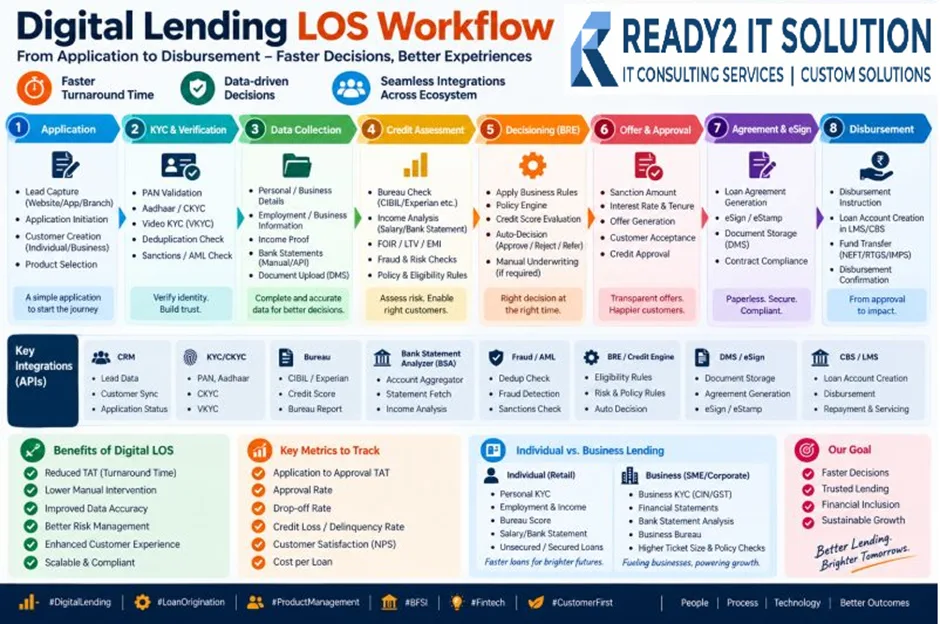
A typical digital lending journey can be represented as:
Application → Customer Creation → KYC & Verification → Data Collection → Credit Bureau → Income Assessment → Risk Checks → BRE Decisioning → Offer & Approval → eSign → Disbursement → LMS/CBS
Each stage plays an important role in reducing turnaround time while maintaining credit quality and compliance.
1. Application & Customer Creation
The lending journey begins with capturing the applicant's information through channels such as:
- Branches and relationship managers
- Web applications
- Mobile applications
- Digital lending partners
- Customer referrals
- Third-party integrations
The LOS should create a centralized customer and application profile while minimizing duplicate data entry.
2. KYC & Identity Verification
Digital KYC is one of the most important building blocks of a modern LOS. Depending on the lending process and applicable regulatory requirements, integrations may include:
- PAN verification
- Aadhaar-based verification
- CKYC
- Video KYC
- Document verification
- Customer authentication
The objective is simple: verify the customer's identity quickly and reliably before moving deeper into the credit process.
3. Data Collection & Validation
Once the customer is onboarded, the LOS needs to collect the information required for credit assessment. This may include:
- Personal information
- Employment information
- Business information
- Income details
- Bank account information
- Financial statements
- Supporting documents
For business lending, the data requirements can become significantly broader. The quality of this data directly affects the quality and speed of the credit decision.
The Integration Layer Behind Digital Lending
What looks like a simple loan journey to the customer is actually a network of systems, APIs, and decision engines working together. A modern LOS may integrate with:
- KYC & Identity APIs — for customer identification, verification and compliance
- Credit Bureau APIs — for retrieving credit history, scores and existing obligations
- Account Aggregator & Bank Statement Analysis — for analysing financial transactions, income patterns, cash flows and banking behaviour
- Fraud & AML Checks — for identifying suspicious activity, duplicate applications and potential fraud risks
- BRE / Credit Decision Engine — for applying lending policies, eligibility rules, scorecards and automated decisioning
- DMS & eSign — for document management, agreement generation and digital execution
- CBS / LMS — for transferring approved applications into the downstream loan management or core banking environment
- Payment & Disbursement APIs — for enabling automated and controlled disbursement after all required conditions are satisfied
The real value of an LOS is therefore not simply the workflow itself. It is the orchestration of all these systems into one connected lending journey.
Individual Lending vs Business Lending
One of the biggest differences in digital lending is the depth and nature of credit assessment.
Individual Lending
For personal or individual borrowers, the assessment generally focuses on:
- Personal KYC
- Employment information
- Income assessment
- Credit bureau history
- FOIR / affordability
- LTV, where applicable
- Salary or bank statement analysis
- Existing obligations
- Secured or unsecured lending policies
The objective is to determine whether the individual has the identity, income capacity and credit profile required to service the proposed loan.
Business & SME Lending
Business lending requires a broader view. A lender may need to evaluate:
- Business KYC
- GST information
- Business bank transactions
- Financial statements
- Business credit bureau information
- Business vintage
- Turnover
- Existing liabilities
- Cash flow
- Promoter information
- Industry and business risk
- Higher-ticket policy requirements
In other words, business lending is not simply individual lending with a higher loan amount. The credit decision often requires a much deeper understanding of the business, its financial position and its ability to generate sustainable cash flows.
Where Does Faster Approval Really Come From?
Many organizations initially look at workflow automation when trying to reduce approval TAT. Automation is important — but it is only one part of the equation.
A faster lending process requires three fundamental capabilities:
1. Do We Have the Right Data?
Incomplete applications, missing documents and manual data collection create unnecessary delays. The LOS should capture the required information at the earliest possible stage and identify missing information before the application reaches credit teams.
2. Can We Trust the Data?
Data must be validated and cross-checked through appropriate sources. For example:
Customer information → KYC verification → Bureau → Banking data → Income assessment → Fraud checks
The more reliable the data entering the decisioning process, the less manual intervention is required.
3. Can We Make the Right Credit Decision?
Once reliable data is available, the next challenge is decisioning. A Business Rules Engine (BRE) or credit decision engine can apply configurable policies such as:
- Eligibility rules
- Credit score requirements
- Income criteria
- FOIR limits
- LTV limits
- Product-specific policies
- Risk rules
- Exception rules
- Approval / rejection conditions
This allows lenders to automate eligible cases while routing exceptions to the appropriate credit team for manual review.
The Role of a Modern LOS
A good LOS should not simply automate the movement of an application. It should act as an intelligent orchestration layer connecting customers, data sources, APIs, credit teams, decision engines and downstream lending systems.
The ideal LOS should help lenders achieve:
- Faster application processing
- Reduced manual intervention
- Better data quality
- Improved credit decisioning
- Lower operational errors
- Better customer experience
- Stronger risk controls
- Seamless integration with LMS/CBS
- Improved visibility across the lending journey
This is where the difference between workflow automation and intelligent lending automation becomes important.
Ready to Speed Up Your Loan Approvals?
Get in touch with our team to see R2S Lending LOS in action.
Request a Demo