
R2S Digital Loan Origination Application (R2S LOS) Doesn’t Work Alone: The API Ecosystem Behind Digital Lending
A borrower opens a lending app, enters a mobile number, uploads a PAN, taps “Accept,” and receives money in their bank account within minutes. To them, it feels like one smooth product.
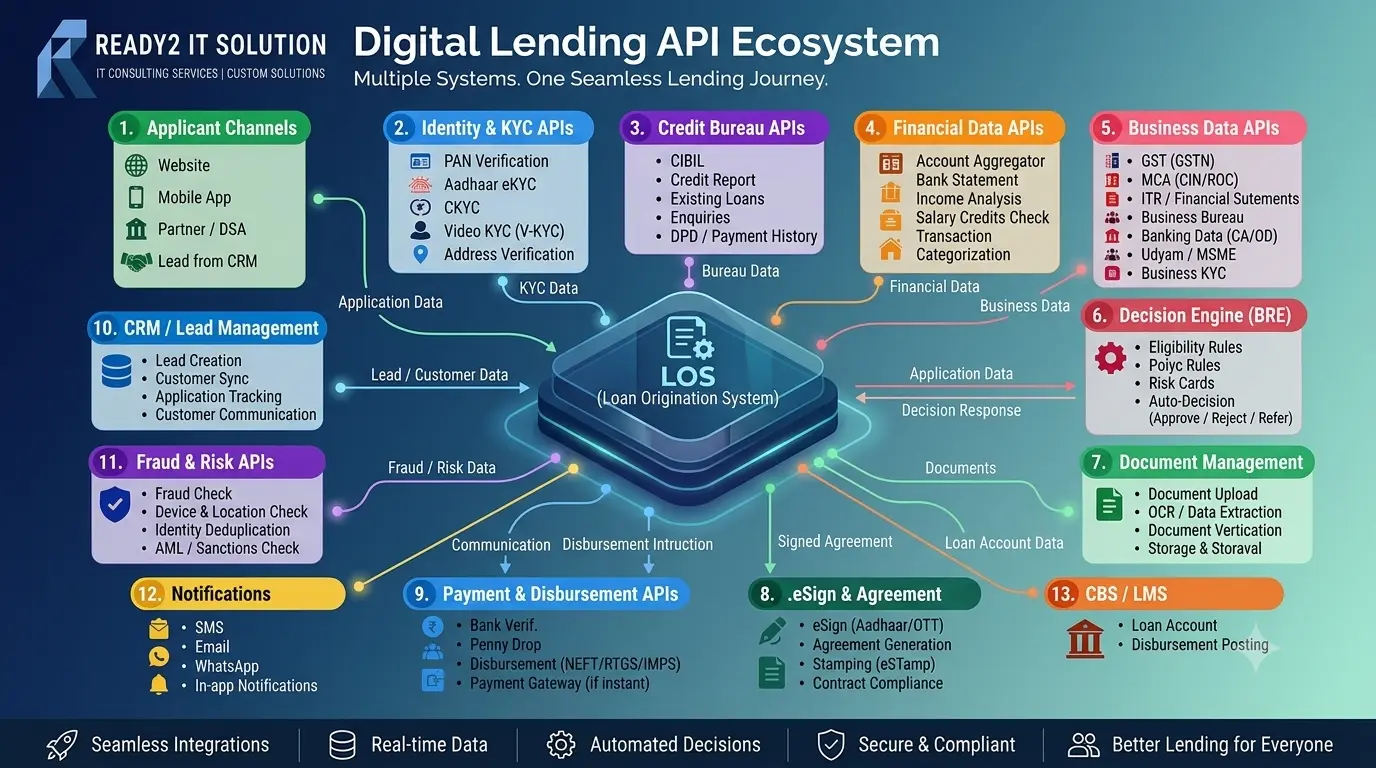
Behind that screen, a dozen or more systems are talking to each other. An identity service confirms who the applicant is. A bureau reports how they have repaid before. A bank data feed shows how money moves through their account. A fraud engine checks for suspicious patterns. A decision engine weighs everything against policy. An eSign service captures consent, a disbursement rail moves the funds, and a loan management system takes over the account for the years ahead.
The Loan Origination System (LOS) sits at the center and orchestrates it all. That is why the R2S Digital Loan Origination Application (R2S LOS) doesn’t work alone: its value comes from how well it connects to everything around it.
A Typical Digital Lending API Ecosystem
A typical digital lending flow looks like this:
Applicant → LOS → KYC → Bureau → Financial Data → Risk/Fraud → BRE → eSign → Disbursement → LMS
It is easy to read this as a straight line, but in practice it is a web. Some calls run in parallel, some depend on earlier results, and some trigger only under certain conditions. A salaried personal loan and an MSME working capital loan call very different combinations of services.
What every version shares is that the LOS is the conductor. It decides which service to call, when, with what data, and what to do with the response. A weak LOS turns the ecosystem into a tangle of point-to-point connections. A strong one turns it into a governed, observable and resilient pipeline.
The Real Value of API Integration
The real value of API integration isn’t just connecting systems. It is about making the right data available at the right time to support:
- Faster application processing – identity, bureau and financial data are fetched automatically, so applications that once took days can move in minutes.
- Better data validation – data pulled from a trusted source is more reliable than data typed in. Names can be matched across ID and bank account; declared income can be compared with actual credits.
- Automated eligibility checks – age, location, income thresholds and existing obligations can be evaluated instantly, before any human effort is spent.
- Consistent credit decisioning – the same rules run on the same structured inputs every time, which is better for customers, auditors and portfolio quality.
- Reduced manual intervention – underwriters and operations teams focus on genuinely complex cases instead of chasing documents.
- Better customer experience – fewer forms, fewer uploads and faster answers, in a market where a borrower can switch apps in seconds.
Key Integrations in a Digital Lending Journey
A single loan application may interact with all of the following.
KYC / CKYC APIs
The front door of the journey. These verify identity and address through PAN validation, Aadhaar-based verification, DigiLocker document fetch, video KYC and retrieval of records from the Central KYC Registry. Without verified identity nothing else can be trusted, and because KYC is a regulatory requirement, failures here are compliance events, not just inconveniences.
Credit Bureau APIs
Bureau data shows existing loans, repayment behavior, enquiries, delinquencies and the overall score. It is often the single most influential data point in a decision, and it must be handled with proper consent, accurate matching and a clear approach for thin-file or no-file applicants.
Account Aggregator / Bank Statement APIs
With borrower consent, financial data through the Account Aggregator framework or bank statement analysis reveals real cash flows: salary credits, EMIs, average balances and bounced cheques. It moves underwriting from what the applicant claims to what the data shows, which is especially powerful for self-employed borrowers and small businesses.
GST / MCA / Business Data APIs
For business lending, these sources provide turnover trends, filing regularity, company registration details and directorship, helping validate that a business is real, active and consistent with what its owners declare.
Fraud & AML Systems
Device and identity fraud checks, duplicate application detection, sanctions and watchlist screening, and anomaly detection protect both the balance sheet and the institution’s regulatory standing.
BRE / Credit Decision Engine
The Business Rule Engine turns policy into automated decisions by combining bureau scores, income estimates, fraud flags and product rules to approve, reject, refer or counter-offer. A well-configured BRE lets policy change through configuration rather than a software release, and keeps every decision explainable.
DMS & eSign
Document management stores supporting documents, while eSign captures legally valid consent on the loan agreement and sanction letter. Together they replace paperwork with a secure, auditable trail and make same-day disbursal possible.
Payment & Disbursement APIs
Penny-drop account verification, e-mandate registration and fund transfer through rails such as IMPS, NEFT or UPI. This is the moment of truth for the customer: a failed or delayed disbursement after a smooth application erodes trust quickly.
CBS / LMS
Once disbursed, the loan moves into the Loan Management System and often the Core Banking System for repayment schedules, collections, statements and closure. If the handoff from LOS to LMS is imperfect, errors compound over the life of the loan: wrong EMI amounts, mismatched borrower records or missing documents during collections.
What Happens When One of These APIs Fails?
But there is one important Product & Technology question that teams often ask too late:
What happens when one of these APIs fails?
Every architecture diagram assumes each box responds correctly and quickly. Real life does not. Bureaus have downtime windows. Government-linked services slow down at peak hours. Bank statement fetches time out. Consent journeys are abandoned midway. A payment rail returns an ambiguous status. Providers change response formats without notice.
In digital lending, API failure is not an edge case. It is a normal operating condition, and it has consequences everywhere: customers face spinning screens and lost applications, operations teams face growing queues of stuck cases, credit teams risk decisions on incomplete data, and compliance teams face gaps in the audit trail.
A robust LOS should be designed for:
Timeout → Retry → Validation → Fallback → Exception Handling → Manual Review
Building a Robust LOS Integration Layer
Timeout
Every external call needs a defined time limit. Without one, a slow dependency can hold up threads, freeze the interface and cascade into wider slowdowns. Timeouts should be tuned per service, since a bureau pull and a PAN check have very different normal response times, and they should be visible in monitoring.
Retry
Some failures are transient, such as a network blip or a momentary overload. Controlled retries with increasing wait times and a sensible cap can resolve many of these invisibly. Two cautions apply: retries must be idempotent, so a repeated disbursement request never pays out twice, and they must have limits, so a struggling service isn’t hammered into deeper failure.
Validation
A response that arrives is not necessarily correct. The LOS should validate structure, mandatory fields, data types and business sanity before using the data. A bureau response with a valid score but missing account details should not be silently treated as a clean record. Bad data accepted quietly is often worse than an outright error.
Fallback
When a primary service is unavailable, is there an alternative? Options include a secondary bureau or KYC provider, uploaded statements when an Account Aggregator fetch fails, or a deferred check that lets the application progress while data is fetched later. Fallbacks should be governed by credit policy, not improvised, and each one should be logged.
Exception Handling
Some failures cannot be resolved automatically. The LOS should classify them (temporary, permanent, data-related, policy-related), route them to the right queue and give the customer honest, useful messaging. “Something went wrong” is not a customer experience strategy. “We’re verifying your bank details and will update you shortly” is.
Manual Review
There must always be a human-in-the-loop path. When automation cannot conclude, a trained user should see exactly what succeeded, what failed and why, make a documented decision, and resume the workflow without starting over. Manual review is not a sign of failure; it is the safety net that keeps the pipeline honest.
Design Principles for a Resilient LOS
- Decouple through an integration layer. A dedicated layer standardizes requests and responses, so switching a provider, adding a second one or handling a version change is a contained task instead of a system-wide change.
- Make workflows configurable. Product teams should be able to adjust which checks run, in what order and under what conditions, without rewriting code.
- Preserve state. If a customer drops off after KYC and returns two hours later, they resume where they left off. If a bureau call fails at step five, steps one to four are not repeated.
- Log everything that matters. Every request, response, decision and override should be traceable for audits, disputes and root-cause analysis.
- Monitor proactively. Track success rate, latency and error patterns for each integration, so you find out before your customers complain.
- Handle consent and data responsibly. Consent capture, secure storage, retention rules and access controls must be built into every integration and aligned with applicable digital lending guidelines.
- Test failure deliberately. Simulate timeouts, malformed responses, duplicate callbacks and partial outages before going live, not just the happy path.
Why API Integration Matters in Digital Lending
Because in digital lending, API integration isn’t just a technical requirement. It directly impacts the customer journey, operational efficiency, and credit decisioning. Resilience shows up in business metrics: higher conversion because fewer customers drop off due to errors, faster turnaround even on bad days, lower operating cost from less manual rework, better portfolio quality from validated data, and stronger regulatory confidence from clean audit trails.
A lender with an average decision engine and excellent integration resilience will often outperform one with a sophisticated model that stumbles every time a dependency slows down.
Where R2S LOS Fits In
R2S LOS is built around the reality that a modern LOS is not a standalone application but an orchestration layer for a lending ecosystem. The focus is on:
- Smooth connectivity with KYC, bureau, financial data, fraud, decisioning, eSign, disbursement and LMS systems
- Configurable workflows for different loan products and customer segments
- Structured exception handling, with clear paths for retry, fallback and manual intervention
- Traceability and audit readiness across the application lifecycle
- A clear, predictable customer journey even when systems behind the scenes are under stress
Because the customer never sees the APIs. They only see whether the journey worked.
A Practical Checklist for Product & Technology Leaders
- Does every integration have a defined timeout, retry policy and fallback?
- Which failures are safe to auto-retry, and which need human review?
- Are disbursement and payment calls idempotent?
- Can a customer resume a journey without repeating steps?
- Is there a secondary provider for critical services like KYC and bureau?
- Can policy and workflow changes be made through configuration?
- Do operations teams have clear queues, reason codes and visibility into stuck cases?
- Are all API calls and decisions logged, and is integration health monitored in real time?
Which Integration Do You Consider Most Critical?
Which integration do you consider most critical in a Digital Lending ecosystem?
- KYC
- Credit Bureau
- Financial Data / AA
- BRE / Decisioning
- Disbursement / LMS
- Other
The Bigger Picture
A Digital Loan Origination Application does not operate in isolation. Its effectiveness depends on how well it collaborates with KYC providers, bureaus, data aggregators, fraud engines, decision platforms, eSign and payment services, and the LMS that carries the loan forward.
Design only for the happy path and you have a demo. Design for timeout, retry, validation, fallback, exception handling and manual review, and you have a lending platform: reliable, efficient and seamless for every borrower.
Ready to Build a Connected Digital Lending Journey?
Discover how R2S LOS can help connect the different stages of your digital lending ecosystem through integrated APIs, decision engines, data sources, eSign, disbursement, and LMS.
Request a Demo